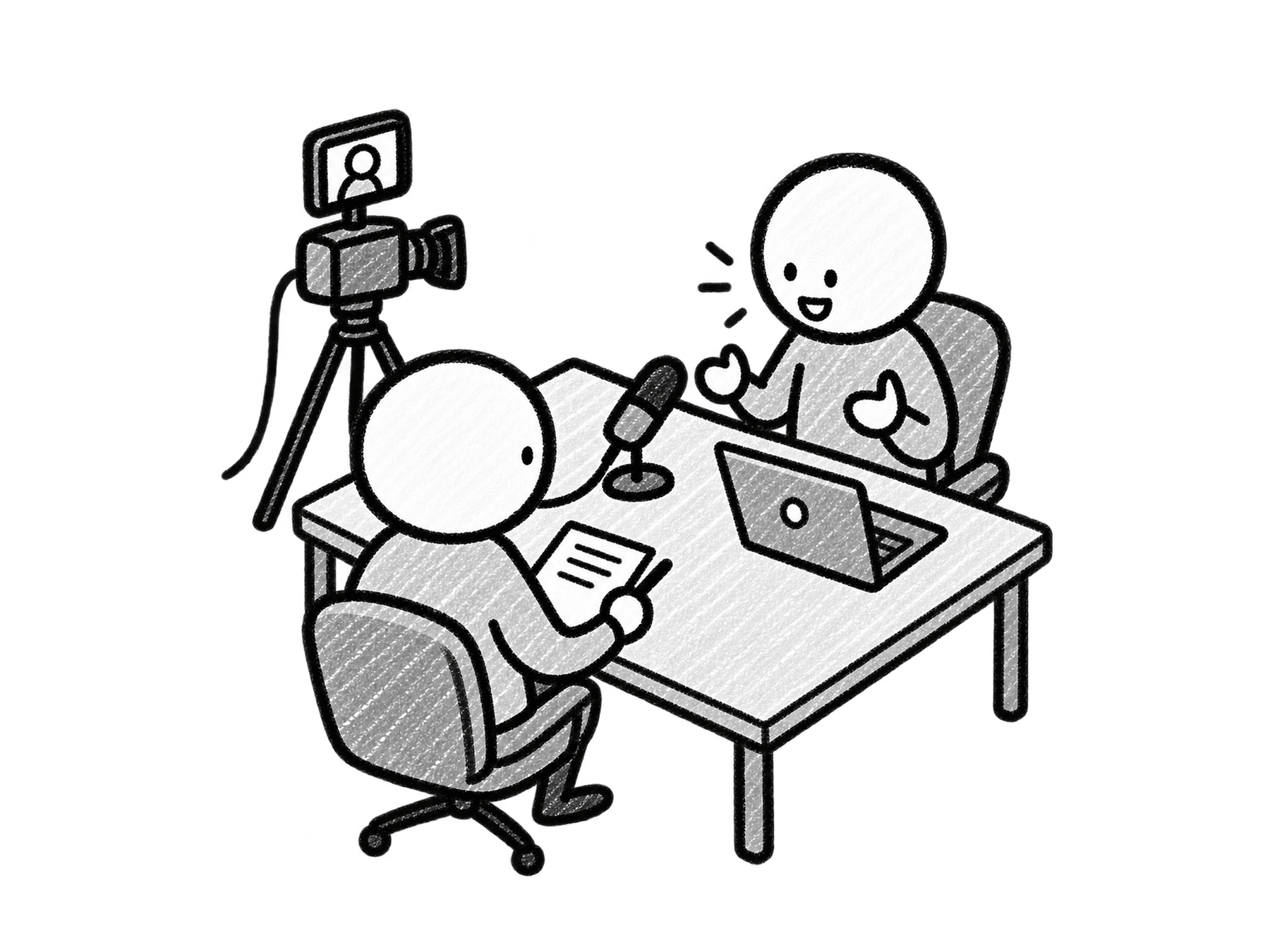
A good employee interview isn't a piece that praises the company on its behalf. It's one that lets candidates picture themselves working alongside you. If you hear “We work autonomously,” ask once more about something the person recently decided on their own and how it turned out. The scene behind the abstract word is your content.
You don't have to ask all 30.
From the questions below, pick the six to eight your readers need and plan a conversation of about 40 minutes. The time split below is an example you can lean on for your first interview.
- Share who will read the piece, what it's for and the main questions ahead of time.
- Agree first on whether you'll record and what can be made public. Customer details and unreleased projects can be discussed without naming names.
- Rather than leading the answer, ask about the experience: “What happened then?”
The role and a day at work
Show the actual work that a job title can't convey. Ask for concrete scenes so candidates can picture their own day after joining.
- How would you explain what you do to someone hearing about it for the first time?
- Walk us through your most recent ordinary day, from start to finish.
- What problem have you spent the most time on this month?
- How is this role different in practice from how people outside imagine it?
- Do you have your own standard for deciding a piece of work is done well?
Follow-up: Could you share one thing you actually made that day, or one tool you used?
How we work together
Instead of saying “We're non-hierarchical,” capture how opinions actually move back and forth. Real examples from meetings and collaboration explain your team's culture for you.
- What problem did you recently solve with a colleague in a different role?
- When opinions on the team were split, how did you reach a conclusion?
- When you need help, who do you ask, and how?
- Has something said in a recent meeting actually changed how the work was done?
- What team agreements should a new colleague know in advance?
Follow-up: Who said what at the time, and how was the final decision shared?
Choices and problem solving
Ask not only about results but about the reasons behind the choice. What the team prioritized and what it gave up reveals how it makes decisions.
- What choice did you recently make on a problem with no right answer?
- Tell us about a time you had to balance the schedule against quality.
- Have you ever changed a plan because of how customers or users responded?
- When a project didn't go as expected, what was the first thing you did?
- If you faced the same problem again today, what would you do differently?
Follow-up: Were there other options? I'd love to hear why you didn't go with them.
Feedback and growth
Go one step past “You can grow here.” Capture the behavior that changed and the environment that helped it change.
- Is there something you found hard when you first joined that now feels familiar?
- What feedback from a colleague actually changed what you do?
- What support did you get when you took on something for the first time?
- Have you recently shared something you learned with the team, or applied it to your work?
- What would you like to get better at, and why?
Follow-up: How did the way you work change before and after that experience?
Culture in everyday work
Ask about the experience of using a policy rather than listing policy names. Showing what's good about the team alongside what it's still working out makes for a fuller story.
- When did you last think, “This is so typical of our team”?
- How does the team celebrate wins and small steps forward together?
- When you need time off or focus time, how do you coordinate your work?
- Of the policies or benefits you've used yourself, which has actually helped your work?
- Is there a habit the team is trying to change right now to get better?
Follow-up: Think of one recent moment that shows that culture best.
To a future colleague
End with information candidates can use to decide. Explaining the role you expect and what onboarding looks like works better than a vague welcome.
- What mattered most to you when you decided to join this team?
- Is there anything you wish you had known before joining?
- What will a new colleague experience in their first month?
- What working style in a colleague brings out the best in you?
- What would you honestly like to say to someone interested in this role?
Follow-up: Is there anything a candidate should prepare or ask about before joining?
Turning answers into a story
Rather than transcribing the interview in order, put the single most concrete experience at the center of the piece. Using the flow below as a base lets you connect the role and the team's culture naturally.
A memorable scene → The role → The problem and the choice → Working with colleagues → To a future colleague
Example title: “Why we pushed the launch back a week, and how we worked it out with customer support”
This is a made-up title to illustrate the structure. Change it to fit your actual interview.
Before publishing, have the interviewee confirm the facts and the quotes. Even when you smooth out an answer, the original meaning has to stay intact. Linking to hiring information for the related role at the end makes it easy for interested readers to find what comes next.
Take it to your next interview.
Copy all 30 questions, the follow-ups and answer fields in one go. Paste them into the document your team uses and keep only the questions you need.
No login needed. Use it right away.